Interactive Slide, Ball Smash & Magic Sand Table: FEC Guide
Teardowns of the five best-selling kids' interactive machines — slide, ball smash, AR sand table, trampoline and floor arrays — with hardware lists, real prices and the revenue logic.
Two family entertainment centers can run the same soft-play structure and still earn very different revenue per square meter. The difference, increasingly, is interactive projection: the same slide, ball pool and sand play, but wrapped in a digital layer that reacts to every child. Below we tear down the five machines that consistently top sales charts — the interactive slide, ball smash wall, magic sand table, interactive trampoline and floor game arrays — including the hardware inside each and the prices we see in the market.
Why Projection Splits the Playground Market
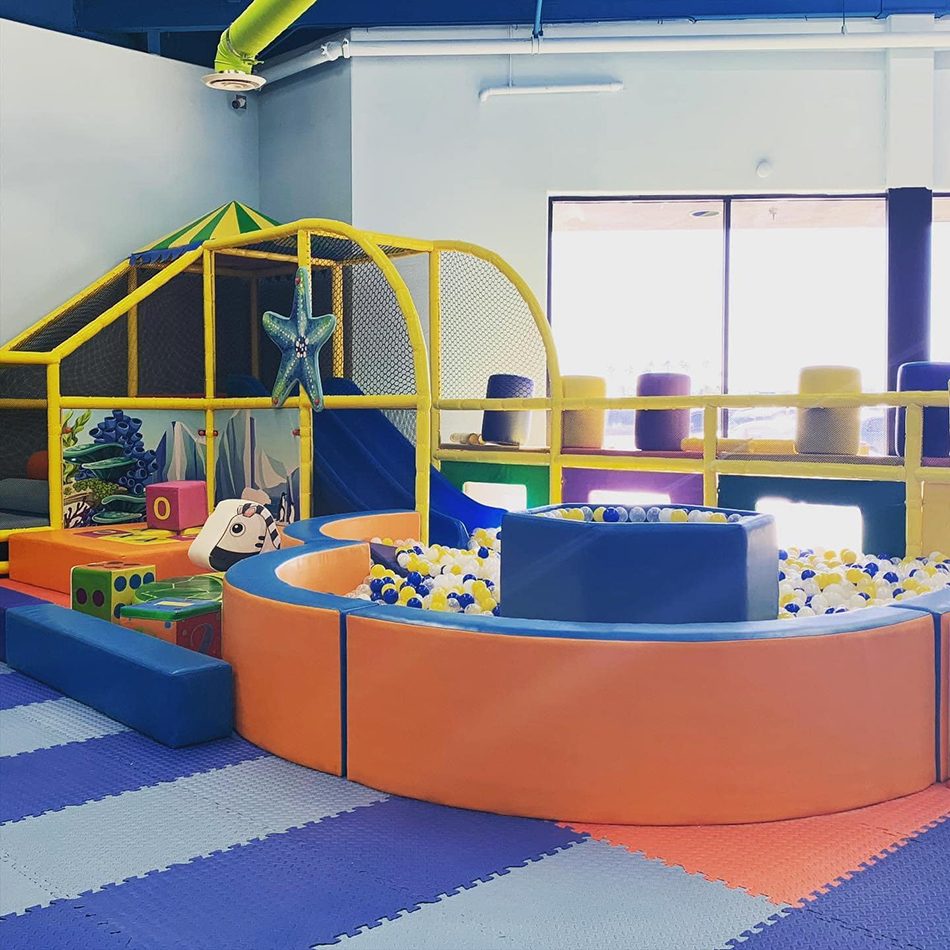
Traditional playgrounds compete on the same slides and ball pools, and children tire of them after two visits. Interactive projection upgrades physical play into physical play plus digital feedback: a child races down the slide and fireworks burst on the wall behind; a ball flies across the room and a monster on the big screen takes the hit. For the owner that means three direct benefits: photo-worthy moments parents post themselves, longer dwell time that feeds food-and-beverage and secondary spend, and updatable content — the same hardware becomes a new attraction with a new theme pack.
Five Hit Machines, Taken Apart
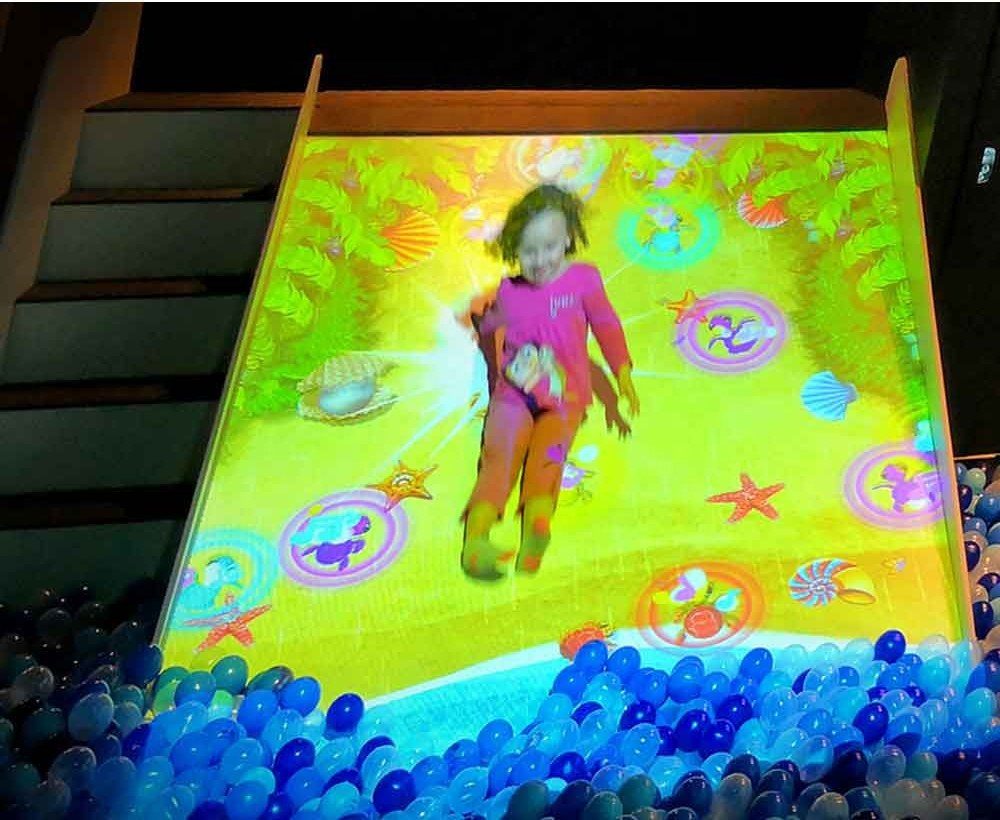
- Interactive slide. A short-throw projector plus sensing camera mounted beside a physical slide fires fireworks, running animals or head-to-head scoring as the child descends. The projection kit runs CNY 7,000-10,000 (about US$1,000-1,400); the slide structure itself is priced separately.
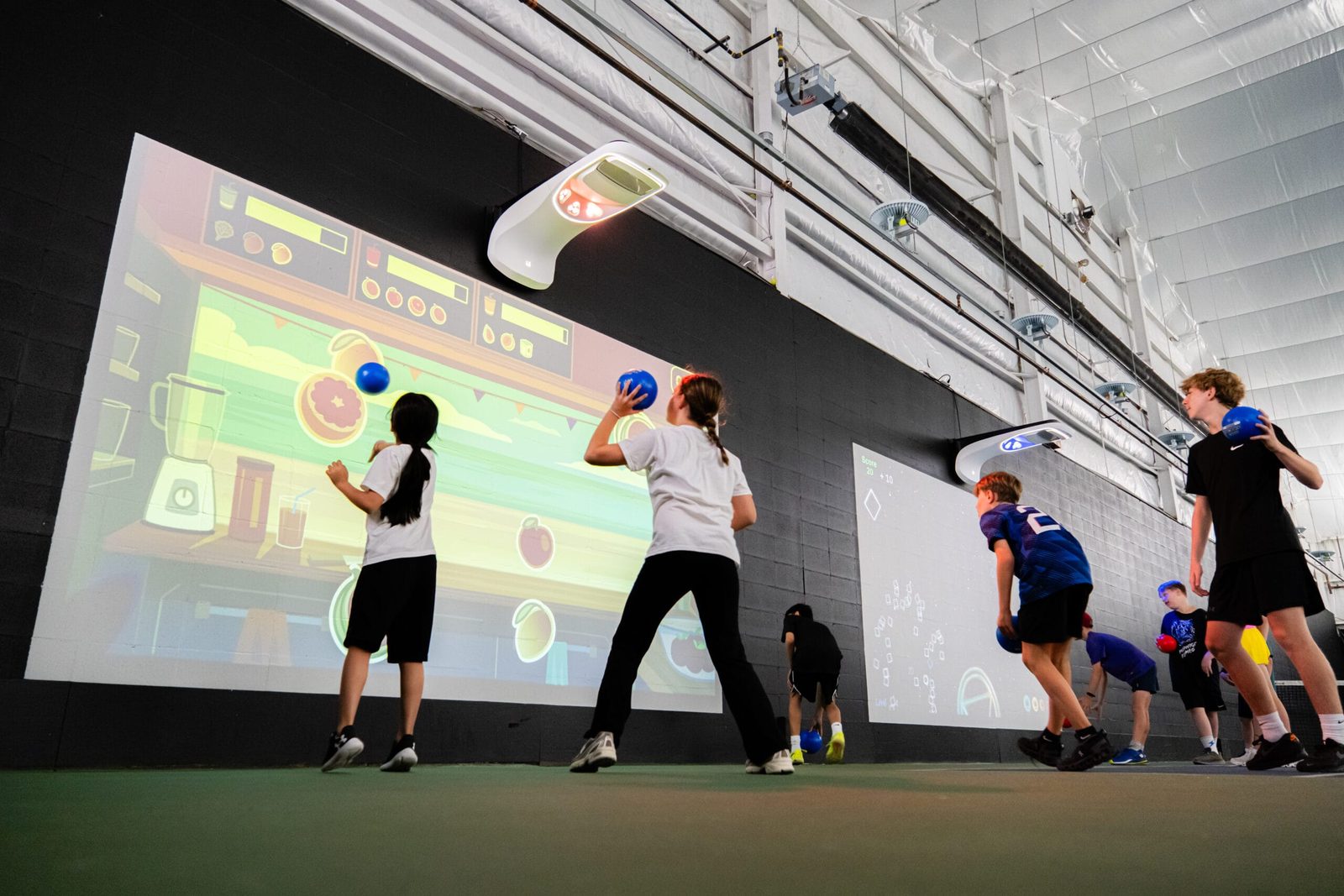
- Ball smash. Children throw ocean balls at a projected wall to hit monsters, moles or the opposing team. It is the classic head-to-head attraction with strong crowd-gathering effect. Wall-mounted all-in-one units start around CNY 8,800 (about US$1,240), software-only systems around CNY 5,800, and mainstream vendors ship 20+ game themes with customization available.
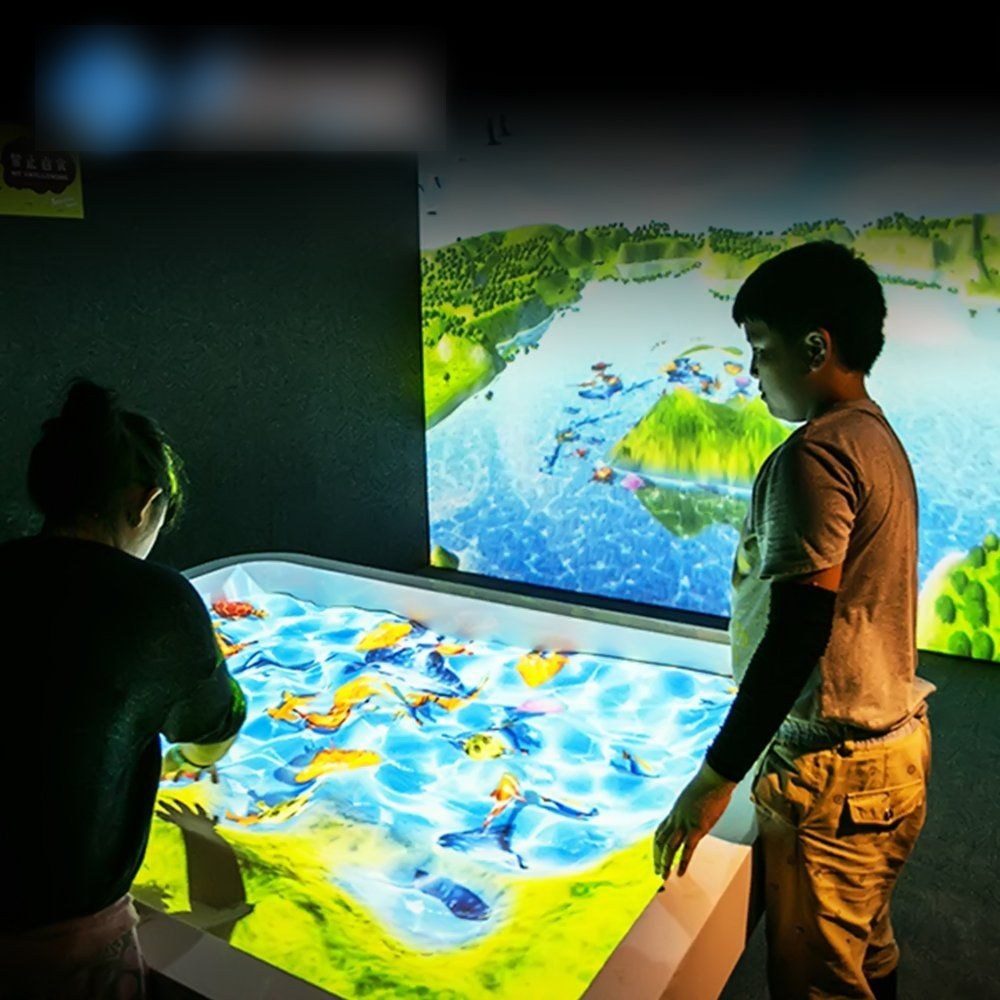
- Magic sand table (AR real-time terrain). A depth camera reads the sand surface while a short-throw projector renders it live as volcanoes, oceans, lakes and dinosaurs — pile a mountain and snow caps and forests appear instantly. It is the star of science and sensory education and a common fixture in special-education therapy. All-in-one units run about CNY 12,800 (US$1,800), dinosaur-theme versions CNY 15,800-16,800.
- Interactive trampoline. The mat is divided into projected game zones; jumping stomps monsters or races opponents, turning pure exercise into goal-driven play. Trampoline parks use it as the anchor attraction.
- Floor game array. Interactive floor projection laid along walkways — ripples, virtual football, snow footprints. Low cost, wide coverage, and it carries traffic from the entrance to the paid zones.
Price Table and Bundle Budget
| Project | Hardware inside | Market price | Role in the park |
|---|---|---|---|
| Ball smash | Projector + camera + host + ball pool | CNY 9,000-20,000 (US$1,270-2,820) | Traffic-driving head-to-head |
| Interactive slide | Projector + sensing + host (excl. slide) | CNY 7,000-10,000 (US$1,000-1,400) | Upgrade for existing structures |
| Magic sand table | Depth camera + short-throw + sand table | CNY 13,000-17,000 (US$1,830-2,390) | Paid educational station |
| Interactive trampoline | Fusion projection + pressure or visual sensing | CNY 30,000-80,000 (US$4,200-11,300), 4-6 surfaces | Paid active attraction |
| Floor game array | Projector + radar or camera units | CNY 6,000-100,000 (US$850-14,100) by area | Route ambience |
For a 300-500 sqm park, a working bundle is one ball smash wall, one slide kit, two sand tables and one floor interaction zone — roughly CNY 30,000-100,000 (US$4,200-14,000) in total. Against traditional playground equipment that is a modest line item, and unlike the frames and slides it keeps appreciating through content updates.
The Revenue Logic: Traffic, Paid, Repeat
Well-run parks split machines into three layers at roughly a 4:3:3 ratio. Traffic drivers (floor games, ball smash) are low-threshold and draw crowds. Paid experiences (sand table classes, timed trampoline) charge per session or per class and carry margin. Repeat drivers (season rankings, badge-collecting missions) turn first visits into habits.
Judge every machine by three numbers: revenue per square meter per hour, the share of parents taking and posting photos, and the 30-day return rate. Content updates decide the third one — the same ball smash runs pumpkins at Halloween and red-envelope games at Lunar New Year, and children come back for it. Before signing, confirm the game library size, updates per year and whether updates are charged; that clause shapes your real three-year return.
Safety Red Lines and Export Notes
- Structure: rounded corners on sand tables and slides, E0-grade or better boards, adequate soft padding.
- Electrical: projectors and hosts mounted out of children's reach, concealed wiring, leakage protection on every circuit.
- Light and floor: brightness matched to ambient light with no glare into eyes; non-slip flooring in all play and sensing zones.
- Content: no violence, no dark patterns, adjustable volume.
- Export: confirm 110V/220V, local plug standards and CE/UL certification before ordering.
Aurora Vision ships interactive playground systems with multilingual game libraries and full export documentation. Send us your park layout and we will propose a machine mix with per-zone coverage drawings.